A new instrument · iPad
Harmony, as geometry
you can play.
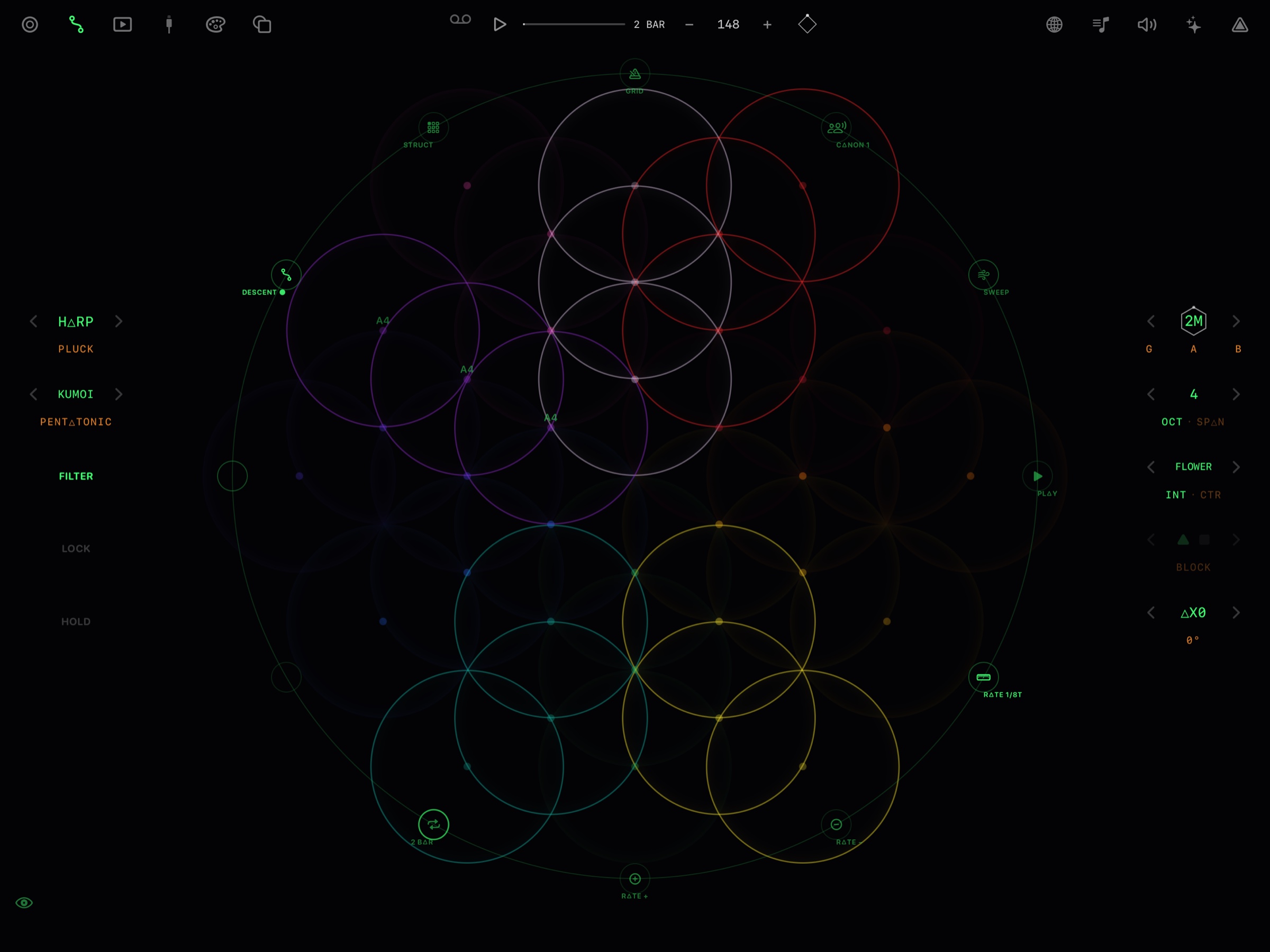
Axis Gemina arranges the twelve tones by their real symmetry, not by keyboard convention. Chords, scales and progressions stop being lists to memorise and become places your hands learn — on a surface that responds like matter.
Join the betaWhere it starts
The symmetry was always in the piano.
Look at any keyboard: the black keys are mirror-symmetric around D. Reflect the keyboard at D and every key lands on a key — C onto E, C♯ onto E♭, B onto F. That axis, and its twin at A♭, has been sitting in the instrument for three centuries.
Axis Gemina is that fact, taken seriously: no cosmology, no mysticism — the symmetry that was always in your instrument, made visible and playable. A tool for musicians, producers and educators, built on arithmetic you can check tonight on your own piano.
The name
Axis. Gemina.
Every key owns two axes
The mirror of its scale — in C major, D–A♭, the line the whole scale reflects around — and its one tritone, F–B, the pair that defines the key. They are perpendicular: a cross. Rotate the cross and you modulate.
The twelve tones are twins
Two rigid six-tone wheels — the whole-tone families — one carrying each axis. Every key change, every gear, every symmetry in the instrument is these twins turning together or against each other. Twin wheels, twin axes: Axis Gemina.
The instrument
Built from the structure of the twelve tones — then played by touch.
Every note has a position determined by the symmetry of the chromatic system. Rings are octaves. The scale you choose acts as a lens: the full instrument is always there, your current scale is lit. Multitouch, glissando, chords, per-note dynamics — on a surface with real physics that sinks under the finger and ripples through the mesh.
Harmony around the edge
The diatonic chords of your key sit on the rim, each beside its root — triads, sevenths, or fixed chord families across all twelve roots.
Chords that sweep the figure
H△RP turns any chord into a one-shot sweep across the whole instrument — ring by ring, in serpents, along the spokes. Not a pattern preset: a path through geometry.
Transposition is rotation
Changing key rotates the system — every note flies to its new seat before your eyes. Modulation stops being abstract: it is a movement you can follow.
The figures
One instrument, many bodies.
The same twelve tones pour into different moulds: triangle, diamond, pentagon, hexagon, circle — and spirals, where every octave joins into one continuous thread, the whole keyboard as a single climbing line. Each figure changes how distances fall under your hands, so each one plays differently and — in the sequencers — grooves differently. The mould is a musical decision.
Gear — six arrangements of nearness
What sits next to each note
is a musical decision.
The twelve tones are two rigid six-tone wheels. GEAR rotates one against the other, 60° per step — and that single number decides which harmonic relationship becomes physical adjacency. Same instrument, six geographies. Practice stops being memorisation: the progression is literally under your fingers.
| Position | Beside every note | What falls under the hand |
|---|---|---|
| GEAR 0 | its semitone | chromatic runs, clusters |
| GEAR 1 | its leading tone | resolutions |
| GEAR 2 | its relative minor | Cmaj7 · Am7 · Dm7 · Bm7♭5 — contiguous |
| GEAR 3 | its fifth | whole keys as arcs — the circle of fifths, playable |
| GEAR 4 | its fourth | ii–V pairs, side by side |
| GEAR 5 | its minor third | modal interchange |
Geometric sequencing
No step grid. No piano roll.
The shape is the sequence.
In Orbit, a note's duration is not programmed — it emerges from how long a vertex crosses a gate. In Walk, rhythm is carved by the physical distance between notes. We don't know of another sequencer that works this way: these patterns cannot be written in a piano roll, because they are properties of a shape, not entries in a grid.
The figure rotates
Gates on the rim read the turning figure. A note lasts exactly as long as its vertex crosses an open gate — duration emerges from geometry, not from a step grid. Grab the rim and scratch it like a platter.
The figure stands, a cursor travels
Seven routes walk the structure — descending rings, serpents, rays, mazes, drunk walks — with up to four canon voices. In EDGES timing, the distance between nodes carves the rhythm: long leaps take longer. The geometry is the groove.
Both run on one transport with one cycle — so anything they produce drops straight into the looper.
Looper & Session
It was already recording.
The looper listens permanently at the engine's output. Play something good, tap an empty loop cell — and the cycle you just played is already in it. Retrospective capture: no count-in, no ceremony.
Six loop cells, each keeping the instrument it was recorded with — layer a kalimba bass under a harp arpeggio under a pad, and keep playing live on top with your current sound. Mutes land on the downbeat, never mid-phrase.
Everything you played, as a file
Arm SESSION and every note that sounds — touch, chords, sweeps, sequencers, loops — is written to a standard MIDI file, each voice on its channel. Your takes appear beside the built-in repertoire, ready to replay, visualise, or drop into your DAW.
A MIDI visualiser with the same eyes
Load any MIDI file — a classical repertoire ships included — and watch it land on the instrument, every voice a beam to its note.
Who it's for
Practice. Compose. Perform.
Practice
Progressions as geography: set GEAR 4 and the ii–V–I of every key is a contiguous path. Theory stops being flashcards — you walk it.
Compose
Sketch with the sequencers, resample them into loops, and export the whole session as MIDI for your DAW. Nothing you play is lost.
Perform
A live-looping instrument with six timbres running, hands free on top, and a transport that never leaves the stage. The screen never sleeps mid-set.
Private beta
Play it first.
Axis Gemina is in active development, iterating weekly with a small group of musicians. Leave your email and we'll send your TestFlight invite.